Facsimile Signature: Meaning, Value and How to Identify One
A facsimile signature is a reproduced image of a person’s handwritten signature rather than a fresh signature written individually on that specific document.
It may be produced by printing, lithography, engraving, stamping or another mechanical process. Importantly, a facsimile signature does not automatically mean that the document itself is fake.
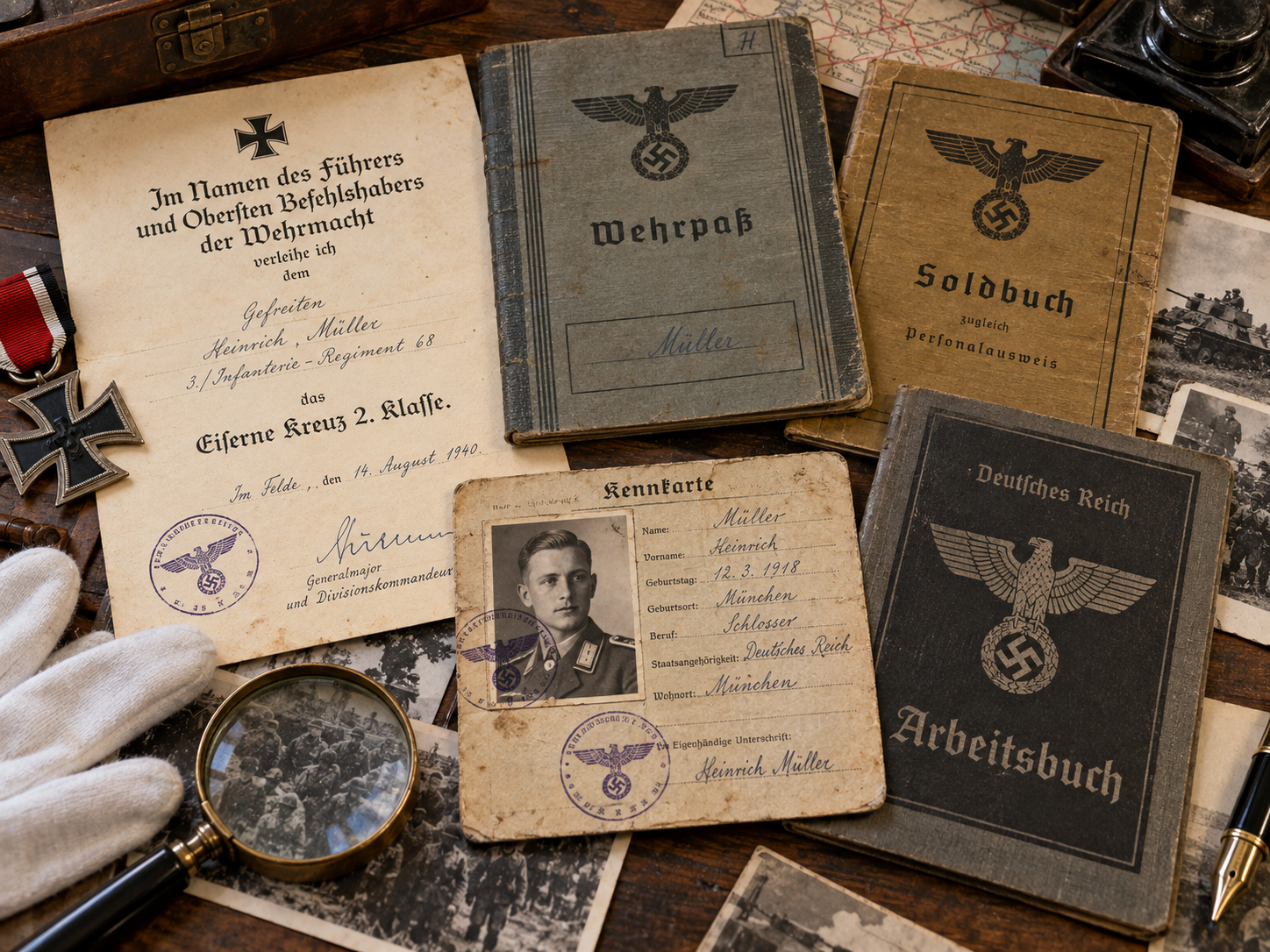
Many genuine historical certificates, official letters, administrative papers and presentation documents were originally issued with reproduced signatures.
For collectors, the distinction matters because an original handwritten autograph, a period facsimile signature and a modern reproduction are three very different things.
Their historical interest, rarity and market value can differ substantially.
The safest approach is therefore not to ask only:
“Is the signature real?”
A better question is:
“What exactly is this document, and how was the signature applied?”
That distinction is at the heart of responsible autograph and historical document collecting.
What Is a Facsimile Signature?
A facsimile signature reproduces the appearance of someone’s handwritten signature without requiring that person to sign each individual document by hand.
The reproduced image may come from a genuine autograph, but once mechanically applied to multiple documents it is no longer an individually handwritten signature.
This distinction is particularly important with official documents.
Governments, companies, military administrations and institutions often issued large numbers of certificates or formal papers. Reproducing an authorised signature allowed those documents to be produced efficiently.
The result can therefore be a perfectly genuine historical document that contains a facsimile signature rather than a personal autograph.
The Library of Congress itself catalogues historical prints containing facsimile signatures, illustrating that the use of reproduced signatures is not a modern phenomenon.
Browse original signed historical documents and autographs.
Facsimile Signature Meaning for Collectors
In collecting terminology, facsimile describes the method by which the signature appears on the document.
It does not automatically describe the authenticity of the document itself.
That produces three situations collectors should keep separate:
| Type | What it means |
|---|---|
| Original handwritten signature | The person physically signed that individual document |
| Period facsimile signature | A mechanically reproduced signature appears on an original period document |
| Modern reproduction | The document or signature was reproduced later and is not the period original |
This distinction prevents one of the most common misunderstandings in autograph collecting.
A document can be:
original, historical and collectible — but not hand-signed.
Equally, a convincing handwritten-looking signature does not make an otherwise incorrect document authentic.
The document and the signature must be evaluated separately before they are interpreted together.
Is a Facsimile Signature Real?
This depends on what the word real is intended to mean.
A facsimile can be a genuine reproduction of someone’s authentic signature.
But it is not a fresh handwritten act performed by that person on that individual sheet.
For collectors, the most accurate description is therefore usually:
“Original period document with facsimile signature.”
That wording communicates both facts clearly.
The historical document may be genuine.
The signature is reproduced.
There is no contradiction between those two statements.
Is a Facsimile Signature Worth Anything?
Yes, but its value normally comes from different factors than an original handwritten autograph.
A facsimile signature by itself generally does not carry the same autograph premium as a personally signed document.
However, the document containing it may still have considerable collector interest.
Its value may depend on:
- historical period;
- issuing institution;
- recipient;
- rarity;
- event or award represented;
- condition;
- visual presentation;
- provenance;
- associated documents;
- whether similar examples survive.
An original wartime award certificate with a facsimile signature, for example, remains an original wartime certificate.
Its value should therefore be assessed as a historical document rather than incorrectly priced as a personally signed autograph.
That distinction protects both buyers and sellers.g
Original Signature vs Facsimile vs Autopen vs Stamp
These terms are often confused.
| Type | Method | Individually handwritten? | Can appear on an original historical document? |
|---|---|---|---|
| Original autograph | Written directly by signer | Yes | Yes |
| Facsimile signature | Reproduced image of signature | No | Yes |
| Autopen | Machine reproduces writing motion | No | Yes |
| Stamped signature | Signature applied using a stamp | No | Yes |
| Modern reproduction | Later copy of document/signature | No | No, as a period original |
For collectors, the important point is not simply whether the signature resembles handwriting.
It is how the mark was produced.
What Is a Signed Document?
A genuinely signed document records a physical act of writing.
The signer placed ink, pencil or another writing medium directly onto that particular sheet.
That process can produce characteristics associated with natural handwriting, including variation in speed, pressure, stroke width and movement.
The Library of Congress notes that signatures on original records can be studied comparatively and stresses the importance of determining whether the researcher is actually examining an original record rather than a copy.
But natural variation is important.
A genuine signer does not reproduce their signature with machine-like precision every time.
Age, writing instrument, physical position, available space and speed can all influence appearance.
Authentication is therefore not a search for perfect duplication.
What Is a Facsimile Signature?
How to Identify a Facsimile Signature: 9 Collector Checks
No single test is conclusive.
The strongest assessment combines several observations and considers the entire document.
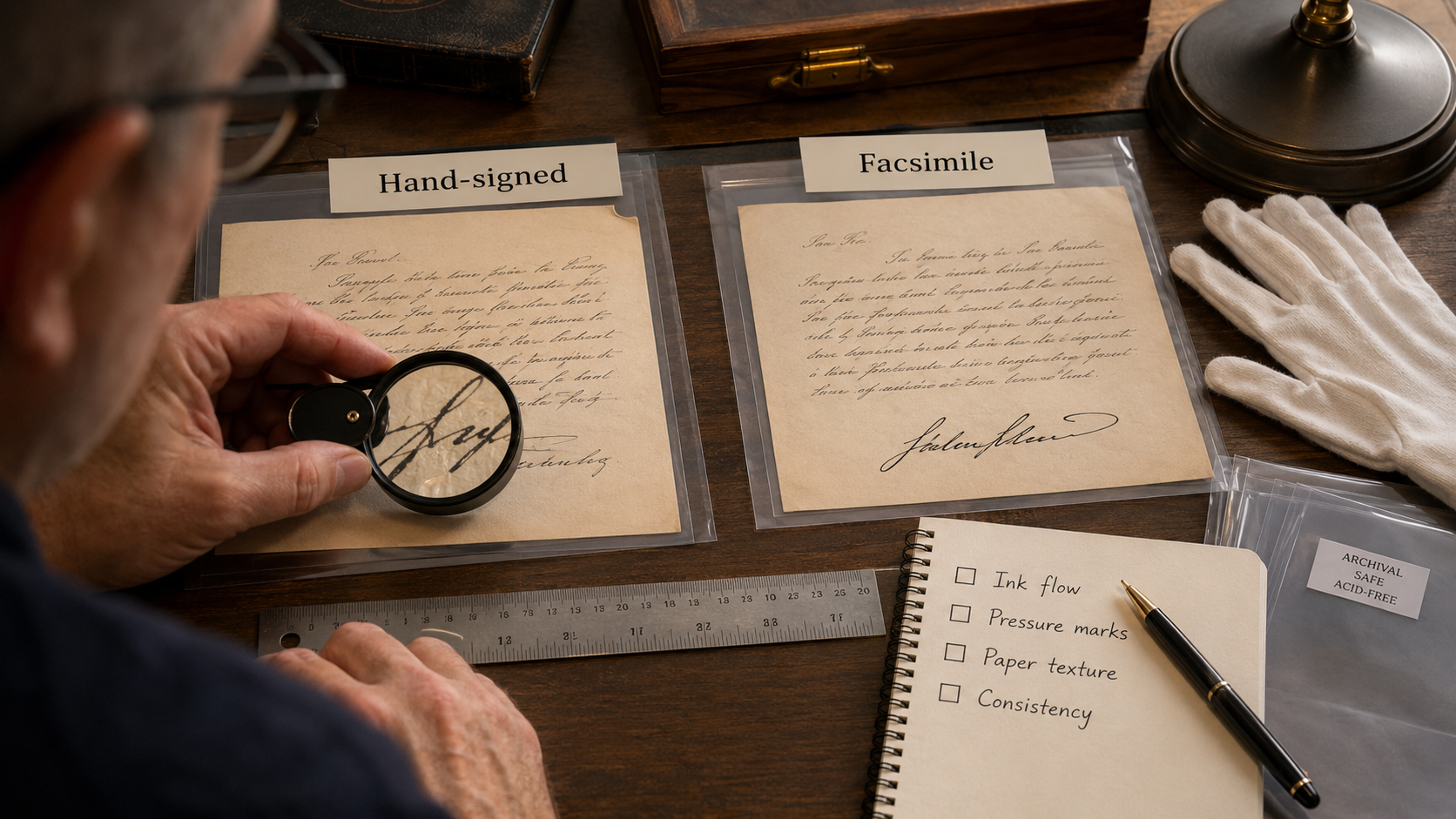
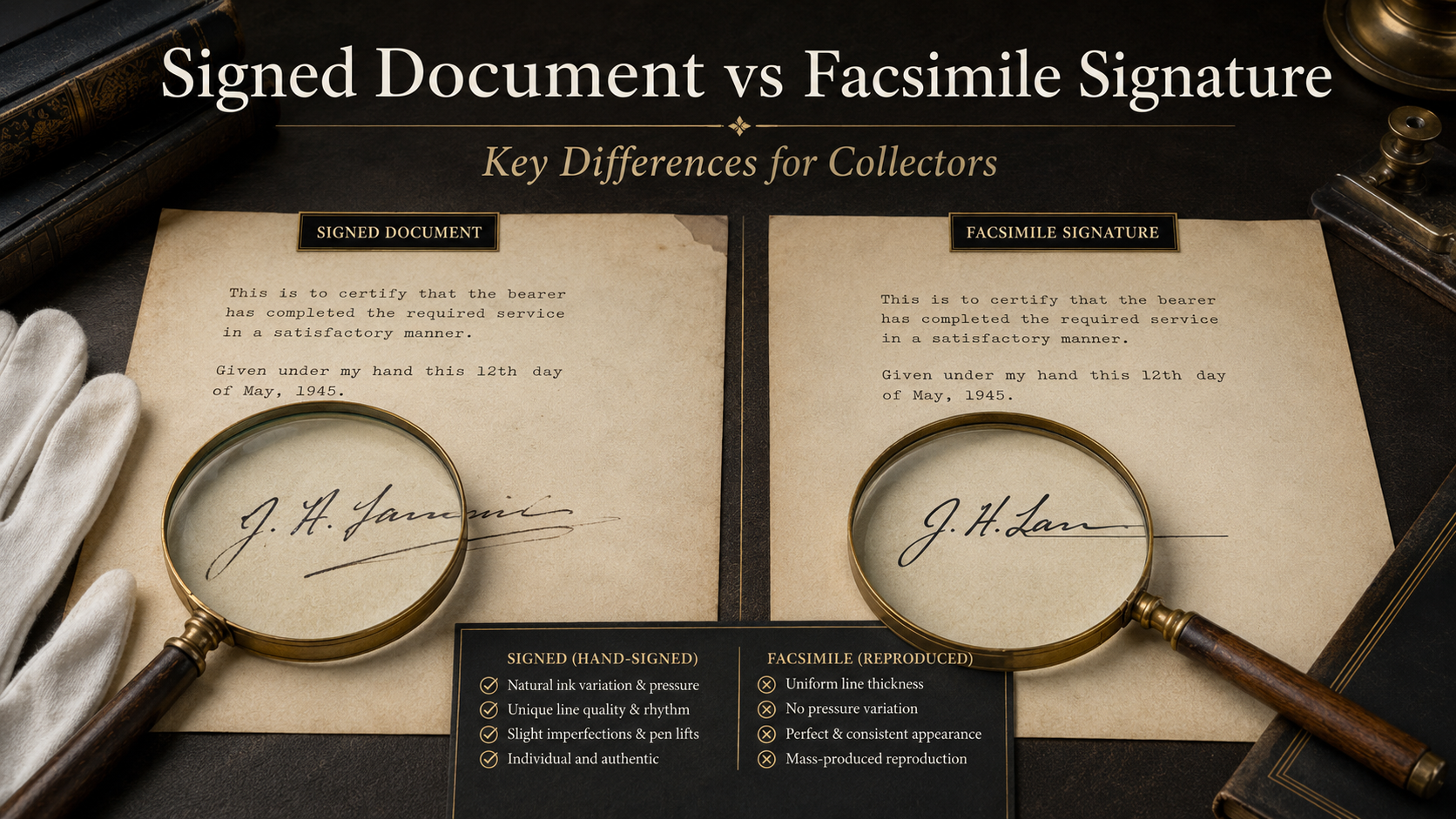
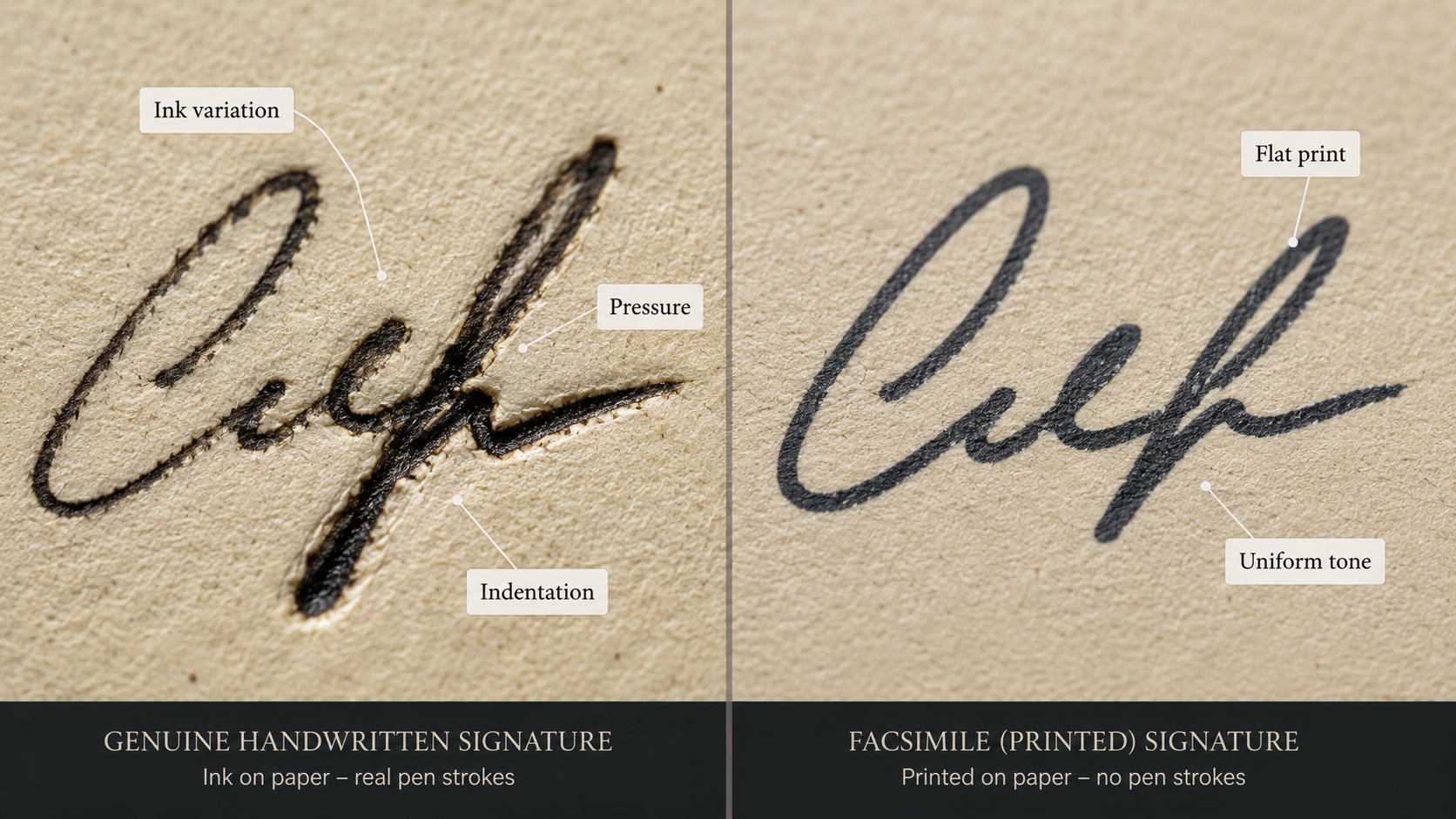
In a hand-signed document, ink may change in density as the pen moves across paper fibres. A slower turn or pause can produce a darker area, while a rapid upward stroke may be lighter or finer. The line can show small changes in width, texture, and saturation.
A facsimile signature often looks more uniform because it was created as an image. This is only one clue: some pens produce even lines and some historical printing looks irregular. Consider paper, date, technique, and context.
1. Look for Ink Variation
A handwritten signature may show changes in ink density, stroke width or saturation as the pen travels across the paper.
A slower turn can leave a darker area.
A rapid upward movement may appear finer.
A facsimile produced by printing often displays more uniform characteristics because it reproduces an image rather than creating fresh handwriting.
However, this is only a clue.
Some writing instruments produce very consistent lines, while historical printing techniques can create irregularities.
Never make a decision from ink appearance alone.
2. Check Pressure and Indentation
Actual handwriting can sometimes leave physical pressure in the paper.
Under oblique or side lighting, heavier downstrokes or changes of direction may reveal slight indentation.
A printed facsimile normally does not create pressure corresponding exactly to the signature.
But collectors should remain cautious.
Folds, embossing, filing pressure and contact with another sheet can produce misleading impressions.
Indentation becomes useful evidence only when it follows the visible writing in a convincing way.
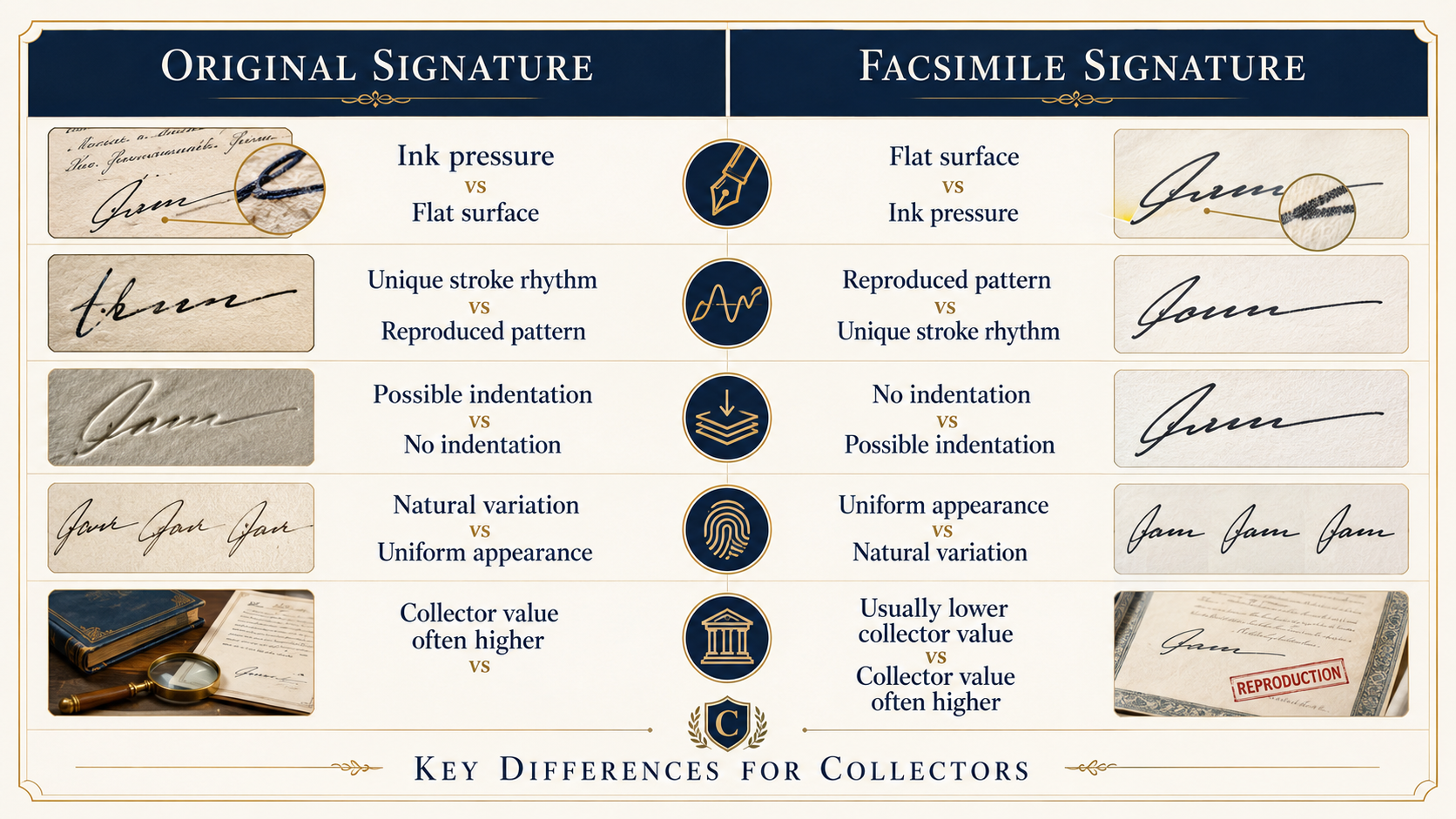
3. Study Rhythm and Line Quality
Handwriting is movement.
Natural writing can display acceleration, hesitation, changing pressure, tapered endings, pen lifts and variation in connections.
A mechanical reproduction copies the appearance of a signature but does not create a fresh writing movement on each document.
One particularly useful clue appears when several supposedly hand-signed documents contain signatures that are absolutely identical.
Natural signatures repeat habits.
They rarely repeat every tiny feature in exactly the same location.
Exact duplication should therefore prompt further investigation.
4. Use Magnification Carefully
A good loupe can reveal how a mark interacts with the paper.
Depending on the writing instrument, handwritten ink may penetrate fibres unevenly or show subtle changes at stroke edges.
Printed processes may reveal dots, screens or other mechanical textures.
But magnification is not magic.
Digital photographs, scanners, image compression, sharpening and contrast adjustments can create patterns that do not exist on the original.
For expensive or historically important items, direct physical examination is preferable whenever practical.
5. Compare Reliable Examples
Comparison is one of the most useful tools available to collectors.
The Library of Congress specifically recommends studying signatures on original records when comparing handwriting and identity.
Compare more than the overall shape.
Look at:
- initials;
- proportions;
- slant;
- baseline;
- connections;
- starting strokes;
- endings;
- dots;
- crossings;
- repeated letter formations.
But remember that genuine handwriting varies.
Differences do not automatically mean a signature is wrong.
The relevant question is whether the differences fall within plausible natural variation.
6. Inspect the Whole Document
Never authenticate a signature in isolation if the document itself is available.
Study:
- paper;
- typography;
- date;
- office or institution;
- seals;
- stamps;
- postal marks;
- filing holes;
- folds;
- wording;
- recipient;
- historical context.
Ask whether the supposed signer actually held the relevant position on that date.
Ask whether the document format makes sense.
A convincing signature on an impossible document is still problematic.
In many cases, the strongest evidence is not actually in the signature.
7. Check Provenance and Disclosure
Provenance is the documented ownership or custody history of an object.
The Smithsonian describes provenance research as an important part of museum practice and notes its usefulness in understanding identity, authenticity and the history of objects.
Useful provenance may include:
- old auction catalogues;
- dealer invoices;
- archive references;
- family documentation;
- collection labels;
- correspondence;
- earlier photographs;
- institutional records.
Provenance should support technical examination, not replace it.
Good descriptions should also state clearly whether an item is:
hand-signed, facsimile signed, stamped, autopen-signed, secretarially signed, attributed or unsigned.
Those terms are not interchangeable.
8. Remember: Facsimile Does Not Mean Modern Fake
This is one of the most important points in the entire article.
A genuine historical document can carry a facsimile signature.
Institutions used reproduced signatures precisely because large quantities of official paperwork had to be issued.
Collectors should therefore separate two questions:
Is the document original to the period?
and
Was the signature individually handwritten?
The answers can be:
Yes — the document is original.
No — the signature is facsimile.
That is not a contradiction.
9. Know When to Seek a Professional Opinion
A low-cost decorative item may only require clear identification and honest disclosure.
A rare autograph, historically significant manuscript or expensive signed document deserves a higher standard of examination.
Professional assessment may consider:
- handwriting comparison;
- writing movement;
- ink;
- paper;
- document construction;
- chronology;
- provenance;
- historical context;
- comparison material.
A responsible opinion should also acknowledge limitations.
Authentication is not certainty created from one visual clue.
It is a reasoned assessment based on the available evidence.
From the Collection: An Original Document With a Facsimile Signature
A useful real-world example is an original German award document in the Autographs & Militaria collection issued in Berlin on 30 January 1944 to Reichsbahnsekretär Eduard Weber for the War Merit Cross 2nd Class.
The certificate is an original wartime document, but the Adolf Hitler signature appearing beneath the official designation is a period facsimile, not a personally handwritten Hitler autograph.
This object demonstrates precisely why accurate terminology matters.
Calling the document “fake” because the signature is facsimile would be incorrect.
Calling it “hand-signed by Hitler” would also be incorrect.
The correct description is:
Original WWII German award document with period Adolf Hitler facsimile signature.
That one sentence preserves both the historical importance of the document and the true nature of the signature.
Why Period Facsimiles Can Still Be Collectible
Collectors do not collect only handwriting.
They collect history.
An original period certificate can preserve:
- a named recipient;
- an exact date;
- an institution;
- an award;
- a military or civil career;
- official typography;
- seals and stamps;
- administrative context.
A facsimile signature does not erase any of that information.
What it changes is the autograph attribution.
A collector purchasing such an object should understand that the value belongs primarily to the historical document, not to a unique handwritten autograph.
That distinction produces more accurate descriptions and better-informed purchases.
Facsimile Signature vs Modern Reproduction
These concepts should never be confused.
A period facsimile was part of the original issuing process.
A modern reproduction is a later copy.
Imagine an official certificate printed and issued in 1944 with a reproduced signature.
That certificate may be a genuine 1944 artifact.
A photographic copy of that same certificate produced decades later is not the original historical document.
Both contain the same visible facsimile signature.
Only one is the period artifact.
For that reason, identification must always extend beyond the signature itself.
What About Autopen Signatures?
Autopen signatures occupy a different category.
An autopen machine mechanically reproduces a signature pattern through a writing instrument.
The resulting mark may therefore contain real ink on the paper while still not having been personally written by the named individual.
This is why the presence of ink alone does not prove a personal autograph.
Collectors need to understand the production method.
Repeated identical signature patterns across multiple examples can sometimes help identify mechanically reproduced signatures.
Certificates of Authenticity
A certificate can be useful documentation, but it should never substitute for examination of the object itself.
Collectors should ask:
Who issued the certificate?
What exactly was examined?
Does the certificate identify the specific item?
Does it include photographs or reference numbers?
What evidence supports the conclusion?
A good certificate records an informed opinion.
It is not a magical guarantee detached from the object.
At Autographs & Militaria, authenticity and provenance are approached through a combination of physical characteristics, documentary context, comparison and historical research rather than one isolated feature.
Frequently Asked Questions About Facsimile Signatures
What is a facsimile signature?
A facsimile signature is a mechanically reproduced image of a person’s handwriting rather than a fresh signature written personally on each individual document.
What does facsimile signature mean?
It means the signature was reproduced from an existing signature image using a mechanical or printing process. It does not automatically mean the document itself is fake.
Is a facsimile signature real?
It may reproduce a genuine signature, but it is not an individually handwritten autograph. A facsimile can appear on a genuine original historical document.
Is a facsimile signature worth anything?
Yes, depending on the document. A facsimile usually does not carry the same autograph value as an original handwritten signature, but an original period document can still have substantial historical and collector value.
Are facsimile signatures collectible?
Yes. Collectors may value documents with facsimile signatures because of their age, rarity, recipient, historical context, institution, design or provenance.
How can you tell a facsimile signature from an original autograph?
Collectors examine ink, pressure, line quality, repetition, magnification, handwriting comparison and the document as a whole. No single test is conclusive.
Can an original historical document have a facsimile signature?
Yes. Many official certificates, administrative documents and formal papers were originally issued with reproduced signatures.
Final Guidance for Collectors
The difference between an original handwritten signature and a facsimile is not a minor technical detail.
It affects how an object should be described, researched and valued.
But collectors should also avoid the opposite mistake:
facsimile does not mean worthless, and facsimile does not automatically mean fake.
A historically important document can remain completely original even when its signature was reproduced mechanically during the original issuing process.
The best collecting decisions come from separating the evidence.
First identify the document.
Then identify the signature method.
Then examine provenance and context.
Finally, consider rarity and value.
That order reduces mistakes and produces far more accurate descriptions.
At Autographs & Militaria, historical autographs and documents are studied as complete objects rather than as famous names in isolation. The objective is to preserve not only the paper and ink, but also the context that gives them historical meaning.
References & Further Reading
Library of Congress — Paleography: Signatures
Useful guidance on studying signatures, comparing handwriting and distinguishing original records from copies.
Library of Congress — Historical material containing facsimile signatures
The Library’s collections include historical printed material specifically catalogued as containing facsimile signatures, demonstrating their established historical use.
Smithsonian Institution — Provenance Research
The Smithsonian explains how provenance research contributes to understanding an object’s identity, ownership history and authenticity.
Autographs & Militaria — Original WWII German War Merit Cross Document 1944
A real collection example of an original wartime document containing a period Adolf Hitler facsimile signature.
Services & Expertise
Positive Reviews
Authenticity Focused

Document Authentication & Certification
Certificates issued for collector and archival purposes

Graphology & Signature Analysis
Independent professional service
About the Author: Juan García Nicolás

Popular products
-
 Original Third Reich Hitler Election Propaganda Set 1933–1936
Original price was: 200,00 €.149,00 €Current price is: 149,00 €.
Original Third Reich Hitler Election Propaganda Set 1933–1936
Original price was: 200,00 €.149,00 €Current price is: 149,00 €.
-
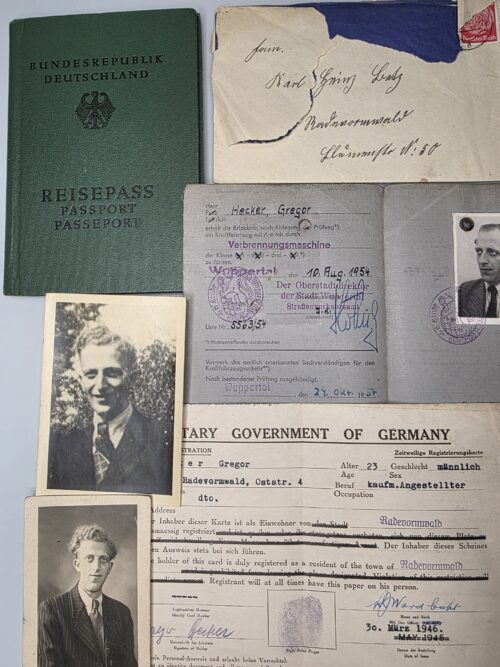 Gregor Hecker Wehrmacht Paper Estate with ISA Certificate, Grenadier-Regiment 753
Original price was: 590,00 €.390,00 €Current price is: 390,00 €.
Gregor Hecker Wehrmacht Paper Estate with ISA Certificate, Grenadier-Regiment 753
Original price was: 590,00 €.390,00 €Current price is: 390,00 €.
-
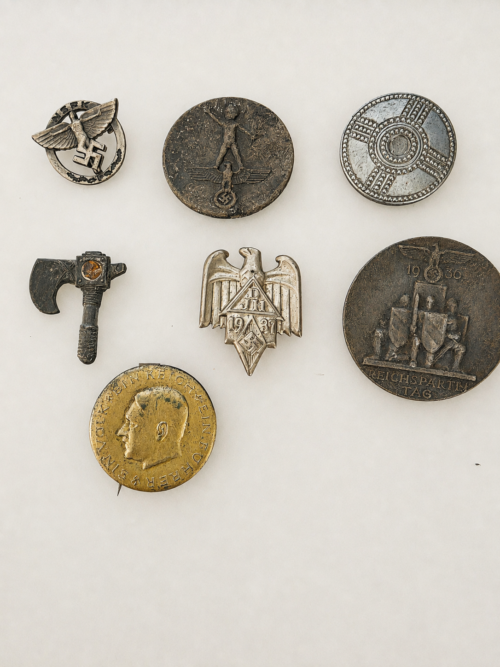 Original WWII German Third Reich Badge Lot – 7 Period Militaria Pieces
99,00 €
Original WWII German Third Reich Badge Lot – 7 Period Militaria Pieces
99,00 €
-
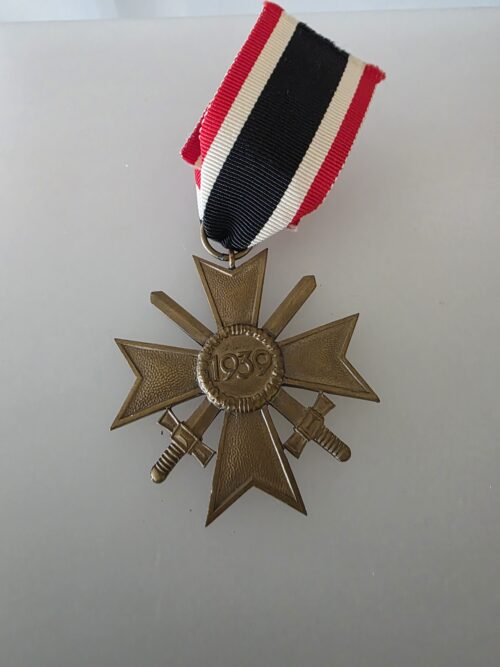 WWII German War Merit Cross 2nd Class with Swords
69,00 €
WWII German War Merit Cross 2nd Class with Swords
69,00 €
-
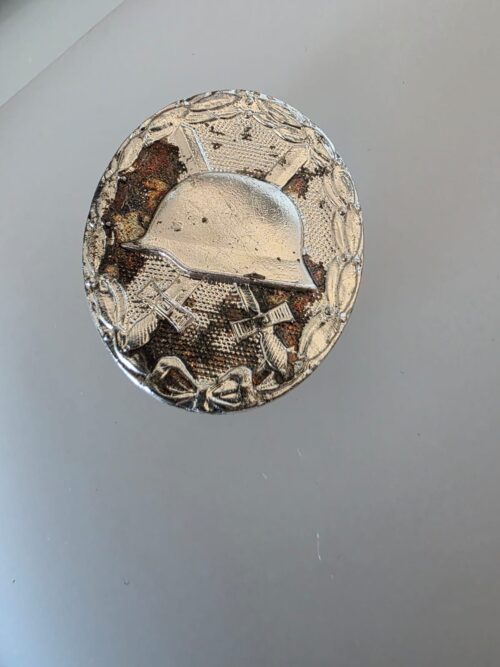 Original 1957 German Silver Wound Badge – Verwundetenabzeichen
65,00 €
Original 1957 German Silver Wound Badge – Verwundetenabzeichen
65,00 €
-
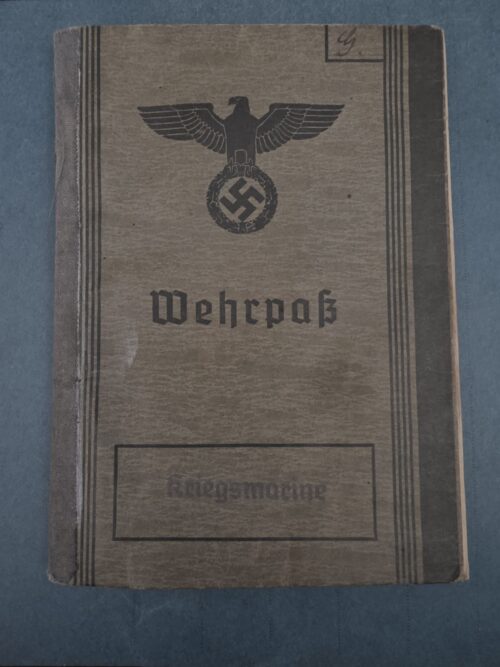 Kriegsmarine Wehrpass – Original WWII German Military Book, 1943
Original price was: 129,00 €.99,00 €Current price is: 99,00 €.
Kriegsmarine Wehrpass – Original WWII German Military Book, 1943
Original price was: 129,00 €.99,00 €Current price is: 99,00 €.
-
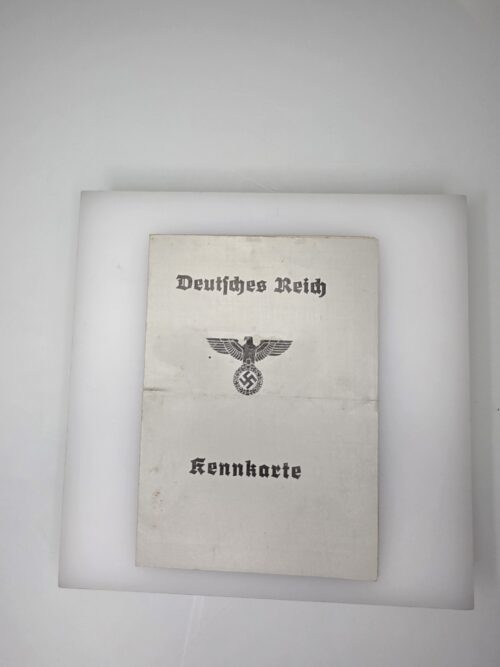 Original German Kennkarte 1942 – Civilian Identity Card from Leonberg
Original price was: 40,00 €.30,00 €Current price is: 30,00 €.
Original German Kennkarte 1942 – Civilian Identity Card from Leonberg
Original price was: 40,00 €.30,00 €Current price is: 30,00 €.
-
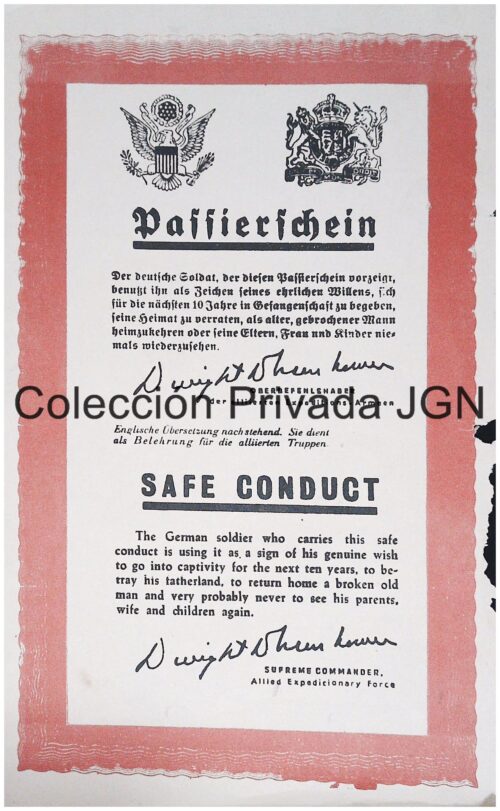 Original WWII Safe Conduct Pass & German Skorpion Counter-Propaganda Leaflet 1944
129,00 €
Original WWII Safe Conduct Pass & German Skorpion Counter-Propaganda Leaflet 1944
129,00 €
-
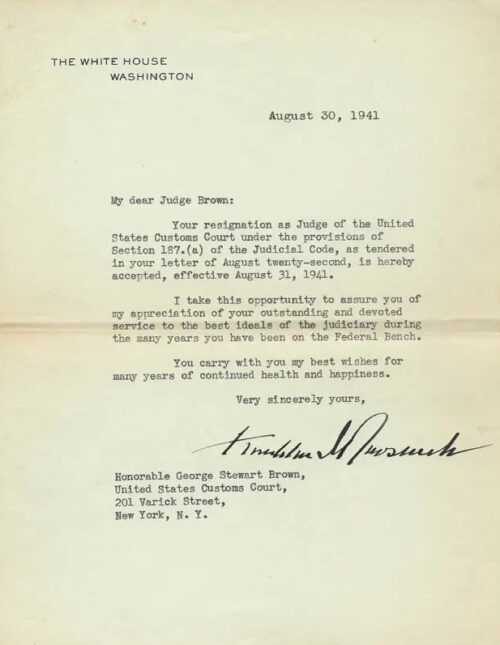 Franklin D Roosevelt Signed White House Letter 1941 Rare COA
Original price was: 1.800,00 €.1.690,00 €Current price is: 1.690,00 €.
Franklin D Roosevelt Signed White House Letter 1941 Rare COA
Original price was: 1.800,00 €.1.690,00 €Current price is: 1.690,00 €.
-
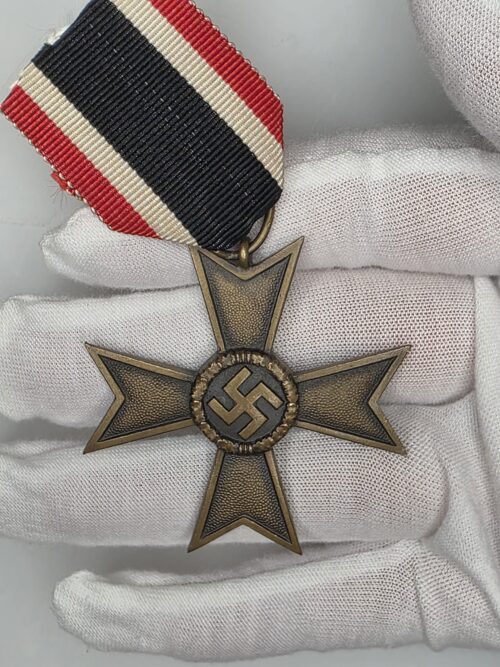 WWII German War Merit Cross 2nd Class Without Swords 1939
Original price was: 69,00 €.50,00 €Current price is: 50,00 €.
WWII German War Merit Cross 2nd Class Without Swords 1939
Original price was: 69,00 €.50,00 €Current price is: 50,00 €.